"Unframing"
Breaking free from structured boundaries
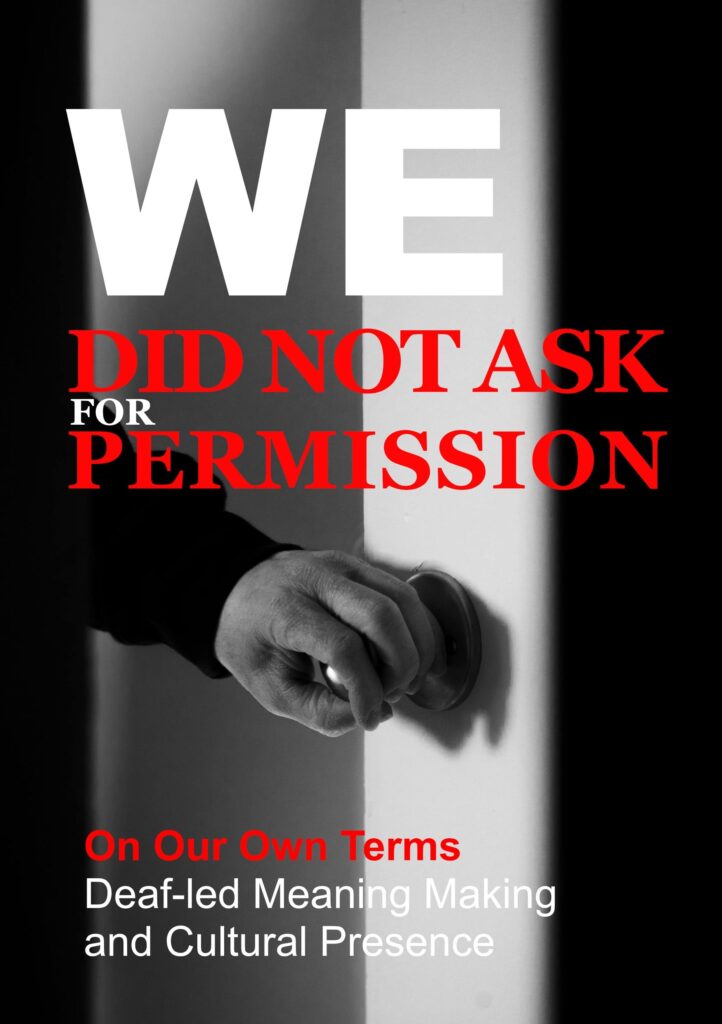
WE DID NOT ASK FOR PERMISSION
On Our Own Terms: Deaf-led Meaning Making and Cultural Presence
This book was not intended to propose a Deaf-led cultural method or platform. It began by listening. Specifically, it started by listening to Deaf participants articulate what museums and cultural institutions consistently failed to provide: not only access, but recognition; not
only interpretation, but presence; not only inclusion, but agency. These accounts of frustration and unmet need formed the initial context of the work and remain historically and politically significant.
However, as the process unfolded, it became clear that focusing exclusively on institutional shortcomings was insufficient. While complaints revealed what was missing, they did not fully account for what was already happening. In workshops, encounters, and collective reflection, Deaf participants not only described exclusion but also actively generated meaning, structured interpretation, guided others, and imagined continuity beyond any single institution or project.
At that point, the center of gravity shifted.
The question moved from what museums fail to do to what Deaf communities are already capable of doing for themselves. This shift was not theoretical or strategic; it emerged directly from practice. Deaf participants did not remain positioned as respondents to institutional frameworks. They became authors of interpretation, holders of method, facilitators of experience, and builders of cultural infrastructure.
This book, therefore, documents a transition: from a politics of complaint to a politics of capacity. Institutional critique remains present, but it no longer defines the horizon of possibility. Museums, cultural institutions, and policy frameworks appear here not as protagonists, but as contexts, spaces in which Deaf knowledge may be exercised, negotiated, or supported, but not dependent.
Why this book is only the beginning
This book does not claim to define Deaf culture.
It does not claim to complete a method.
It does not claim to solve the problem of exclusion.
It documents a turning point.
A moment when Deaf people stopped waiting to be invited into the future and began signing it themselves.
Everything described here is unfinished — deliberately so.
New interpreters will arrive.
New children will watch and reinterpret.
New metaphors will replace old ones.
New platforms will grow beyond SIGNIX’s current scope.
That is not failure. That is life.
This book is not a monument. It is a doorway.
The responsibility of those who come next
To dream is powerful.
To inherit dreams is a responsibility.
Those who encounter this work, Deaf or hearing, are not asked to repeat it.
They are asked to protect what made it possible.
Protect the space for emotion to speak first.
Protect the legitimacy of sign language as knowledge.
Protect the right to interpret without permission.
Protect the slowness required for meaning to emerge.
And above all, protect the future from being imagined too narrowly.
Dreaming forward
The last word does not belong to this book.
It belongs to the next Deaf child who watches a signed interpretation and thinks,
without needing to say it aloud:
I can do this.
This belongs to me.
I will add something of my own.
That is how culture survives.
That is how futures are built.
So the epilogue does not close. It repeats, not as an echo, but as a call:
Dream.
Dream.
Dream.
To Whom this BOOK is for:
· Deaf community willing to empower and create Culture Heritage interpretation ON THEIR OWN TERMS
· Sign language interpreters who want to specialise in Cultural training.
Training available on request: eduagility@gmail.com
This book is not publicly available. If you are interested in accessing it, please submit a request by clicking in the icon below and complete the form. Requests are reviewed individually to understand the professional context and intended use. Access is granted selectively and the content may not be redistributed.
The Generative Art Method (GAM)
The Generative Art Method (GAM) is not a method for producing art, nor is it related to technological or algorithmic forms of so-called “generative art.” The term “generative” is used here to describe how meaning, interpretation, and cultural presence emerge through encounter.
GAM is a Deaf-led interpretive framework in which artworks become catalysts for shared reflection, emotion, and understanding. What is generated is not an object, but a process: a way of seeing, relating, and making sense together. In this context, art refers to the artwork encountered rather than to newly created works. GAM therefore generates meaning, agency, and continuity, rather than artistic outputs.
- Empowered Deaf Leaders: Facilitating Cultural Heritage Access
- Sign Language Interpreters in Cultural Heritage: Quality and Approach
Training Program 1 - "Empowered Deaf Leaders: Facilitating Cultural Heritage Access"
- Duration: 2 days (flexible depending on depth)
- Format: Interactive workshops, group projects, simulations, and practical facilitation exercises
Training Goals
By the end of the program, participants will be able to:
- Lead and facilitate cultural heritage experiences with confidence and inclusivity.
- Apply leadership, communication, and problem-solving skills in real-world heritage settings.
- Advocate for Deaf representation and accessibility of Deaf people in cultural heritage projects.
- Design, implement, and evaluate projects that empower both Deaf communities and broader audiences.
Module 1: Understanding Cultural Heritage
- Introduction to cultural heritage: historical, artistic, and community significance
- The role of cultural heritage in shaping community identity
- Case studies of successful Deaf-led cultural heritage projects
Outcome: Participants gain foundational knowledge of cultural heritage and its value to communities.
Module 2: Leadership for Deaf Facilitators
- Leadership styles and strategies for effective facilitation
- Communication skills tailored to Deaf communities and inclusive audiences
- Building confidence as a Deaf leader in cultural heritage spaces
Outcome: Participants develop leadership skills and confidence to guide cultural heritage activities.
Module 3: Facilitating Access to Cultural Heritage
- Techniques for making heritage experiences accessible to Deaf and diverse audiences
- Planning and organizing guided tours, workshops, or educational activities
- Addressing challenges in accessibility, communication, and audience engagement
Outcome: Participants learn practical methods to facilitate meaningful and inclusive cultural heritage experiences.
Module 4: Community Engagement and Advocacy
- Engaging local communities and stakeholders in heritage projects
- Advocating for Deaf representation in cultural heritage initiatives
- Building partnerships with museums, cultural centers, and organizations
Outcome: Participants understand how to mobilize communities and advocate for greater Deaf inclusion in heritage spaces.
Module 5: Practical Facilitation Exercises
- Role-playing and simulations of guided tours, workshops, and presentations
- Peer and instructor feedback on facilitation style, communication, and engagement
- Problem-solving real-world scenarios in cultural heritage access
Outcome: Participants gain hands-on experience facilitating cultural heritage activities.
Module 6: Strategic Planning and Project Development
- Designing cultural heritage projects from concept to implementation
- Setting goals, timelines, and measuring impact
- Creating inclusive, sustainable, and culturally meaningful programs
Outcome: Participants can plan and execute heritage projects as empowered Deaf leaders.
Module 7: Capstone Project
- Participants design and facilitate a mini cultural heritage experience
- Feedback and evaluation by peers and trainers
- Reflection on leadership growth, facilitation skills, and community impact
Outcome: Participants demonstrate practical leadership and facilitation skills while applying knowledge of cultural heritage.
Training Program 2 - "Sign Language Interpreters in Cultural Heritage: Quality and Approach"
- Duration: 2 days (flexible)
- Format: Workshops, practical exercises, role-playing, and case studies
Training Goals
By the end of the program, participants will be able to:
- Deliver accurate and culturally informed sign language interpretation in heritage contexts.
- Apply advanced techniques to ensure high-quality interpretation.
- Approach cultural heritage interpretation thoughtfully, respecting both content and audience.
- Use technology and tools to enhance accessibility and engagement.
Module 1: Introduction to Cultural Heritage and Interpretation
- Overview of cultural heritage: museums, historical sites, traditions, and storytelling
- The role of interpreters in making heritage accessible
- Understanding the Deaf community’s expectations and cultural perspectives
Outcome: Interpreters understand the importance of cultural heritage and their role in facilitating meaningful access.
Module 2: Core Interpretation Skills
- Advanced sign language techniques for precise and accurate interpretation
- Maintaining accuracy while conveying cultural and historical nuances
- Interpreting complex narratives, metaphors, and context-specific concepts
Outcome: Participants enhance their technical interpretation skills tailored to cultural heritage content.
Module 4: Approach to Cultural Heritage Interpretation
- Strategies for conveying cultural context and significance
- Using storytelling and narrative techniques to enhance audience understanding
- Ethical considerations: respecting historical accuracy and community sensitivities
Outcome: Participants learn how to approach interpretation thoughtfully, balancing accuracy with engagement.
Module 4: Approach to Cultural Heritage Interpretation
- Strategies for conveying cultural context and significance
- Using storytelling and narrative techniques to enhance audience understanding
- Ethical considerations: respecting historical accuracy and community sensitivities
Outcome: Participants learn how to approach interpretation thoughtfully, balancing accuracy with engagement.
Module 5: Practical Application and Simulations
- Role-playing exercises in real-life cultural heritage settings (e.g., museum tours, exhibitions, events)
- Feedback sessions with peers and trainers
- Addressing audience questions and interactive sessions
Outcome: Interpreters gain hands-on experience in applying skills in authentic scenarios.
Module 6: Technology and Tools for Interpreters
- Using visual aids, captions, and digital tools to enhance interpretation
- Introduction to recording or streaming interpretation sessions for wider audiences
- Incorporating technology without compromising quality or cultural context
Outcome: Participants can integrate tools to support and enhance interpretation services.
Module 7: Capstone Project
- Interpreters conduct a full interpretation session for a selected cultural heritage topic
- Peer and trainer review for feedback on quality and approach
- Reflect on learning and create a personal improvement plan
Outcome: Participants demonstrate mastery of interpretation skills and cultural sensitivity in practice.